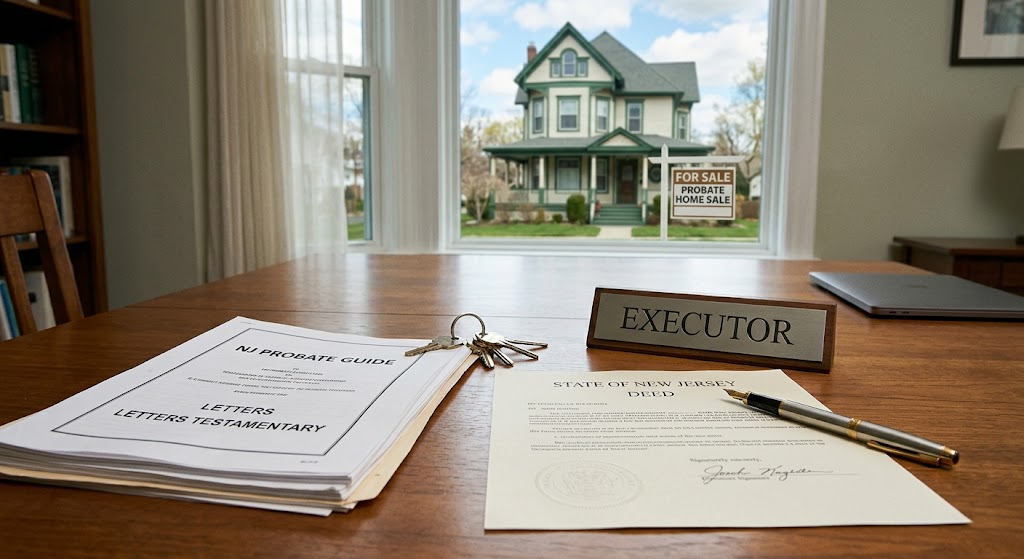
The house may be empty, but a probate home sale rarely feels simple. One person is grieving, another is coordinating relatives from another state, and everyone is watching the carrying costs grow: taxes, insurance, utilities, lawn care, and repairs. The good news is that a New Jersey probate property does not always have to sit untouched until the entire estate is closed. With the right authority, documents, and closing team, an executor can often move the sale forward while the broader probate administration continues.
This guide explains the typical NJ probate home-sale path, what can slow it down, and how an executor can compare a traditional listing with a Fast Home Cash buyer without sacrificing basic due diligence. It is educational information, not legal or tax advice; the estate’s attorney and closing professional should confirm the route for the specific property.
Key Takeaways
- Probate and the home sale are related but separate tracks: the property may sell before final estate distribution.
- The executor generally needs formal authority, a clear title path, and the appropriate New Jersey tax waiver before closing.
- A cash sale may reduce financing and repair delays, but the offer should be judged on net proceeds, certainty, and terms—not speed alone.
- Beneficiary communication and a written decision trail protect the estate from avoidable disputes.
Can You Sell a House During NJ Probate?
In many uncontested New Jersey estates, yes. The County Surrogate’s Court is the filing court for probate-related matters, and the executor or administrator receives documents showing authority to act for the estate. The New Jersey Courts describe Surrogate’s Court as a county office headed by the County Surrogate and used for probate filings. New Jersey Courts Surrogate’s Court glossary
Once appointed, the fiduciary must still act in good faith, follow the will and any court limitations, protect estate assets, and avoid treating the sale proceeds as personal funds. The deed is typically signed in the fiduciary’s representative capacity, and net proceeds belong in an estate account or another properly documented account—not in an heir’s personal checking account.
A disputed will, unclear ownership, creditor issue, missing heir, incapacity, or restriction in the will can change the analysis. In those situations, the estate attorney may need a court proceeding or additional consent before the transaction can close.
The important distinction
Selling the property is not the same as finishing probate. A home can be sold, liens and approved expenses can be paid, and the remaining proceeds can stay in the estate while claims, tax filings, accounting, and distributions are completed. That distinction is often the key to reducing pressure on an estate that is losing money each month.
NJ Probate Home Sale Timeline
There is no universal closing calendar. A straightforward estate with cooperative beneficiaries, clean title, an available death certificate, and a qualifying tax-waiver path can move much faster than an estate with disputes or title defects. Treat the following as a planning framework rather than a promise.
| Stage | What usually happens | Common delay |
| 1. Open the estate | File the will and required documents with the county Surrogate; obtain Letters Testamentary or Letters of Administration and short certificates. | Missing original will, death certificate, bond questions, or an appointment dispute. |
| 2. Stabilize the property | Change locks if needed, confirm insurance, winterize, inspect, secure valuables, and keep utilities appropriate for the home. | Vacant-home insurance requirements, deferred maintenance, or family disagreement about belongings. |
| 3. Confirm title and taxes | The attorney orders title work, checks mortgages and liens, identifies ownership issues, and determines the correct NJ inheritance-tax filing or waiver. | Prior liens, unreleased mortgages, nonresident decedent, non-Class-A beneficiaries, or incomplete records. |
| 4. Choose the sale path | Compare a listing, investor offer, auction, or other strategy using expected net proceeds and certainty. | Unrealistic pricing, repair scope, or beneficiaries who have not agreed on priorities. |
| 5. Contract and review | Sign the contract in the correct fiduciary capacity; allow attorney review and provide required disclosures. | Contract language, inspection findings, buyer financing, or unresolved authority. |
| 6. Clear closing conditions | Deliver the deed, estate authority, tax waiver, payoff figures, affidavits, and title-company requirements. | Waiver or title work not ready, missing signatures, payoff delays, or unresolved claims. |
| 7. Close and account | Sign closing documents, pay approved costs, deposit proceeds, and retain a complete file for the estate accounting. | Last-minute title exceptions, wire instructions, or beneficiary disputes. |
The New Jersey Division of Taxation says an inheritance-tax return, when required, is generally due within eight months of death, and it identifies Form IT-L-9 as a possible route to request release of the state lien on qualifying resident-decedent real property. Eligibility depends on the estate’s facts, so the executor should not assume every property qualifies. NJ Division of Taxation inheritance-tax filing requirements
Documents to Gather Early
A faster sale usually begins with a better file, not a more aggressive sales pitch. Give the closing attorney or title company a clean packet as soon as possible.
| Document or information | Why it matters |
| Certified death certificate | Establishes the decedent’s death for probate and title work. |
| Original will, if one exists | Shows the nominated executor and testamentary instructions. |
| Letters Testamentary or Administration | Demonstrates the fiduciary’s appointment and authority. |
| Short certificates | Often requested by institutions and transaction professionals as proof of authority. |
| Recorded deed and mortgage information | Confirms ownership, liens, and payoff needs. |
| NJ inheritance-tax filing or waiver documents | Helps the title and closing team address the state lien. |
| Property-tax, utility, insurance, and HOA records | Prevents avoidable prorations, lapses, and outstanding-balance surprises. |
| Beneficiary and contact information | Supports notices, communication, and estate accounting. |
| Repair, possession, and personal-property details | Helps price the home accurately and avoid closing-condition disputes. |
Keep originals secure and share copies through a controlled process. If several beneficiaries are involved, send material updates in writing. A simple timeline, decision log, and folder of offers can be valuable if someone later questions why the executor chose one path over another.
Traditional Listing vs. Cash Sale
A listing can produce broad market exposure and may achieve a higher gross price, particularly when the home is financeable and presentable. It can also require cleaning, repairs, staging, showings, appraisal, inspection negotiations, and a buyer’s mortgage approval. A cash offer may be more convenient for an as-is property, but convenience is not the same as value.
| Factor | Traditional listing | Fast Home Cash buyer |
| Repairs | Often expected to improve marketability or satisfy a lender. | Frequently negotiated as-is, subject to inspection and title. |
| Timing | Depends on preparation, buyer search, contract, financing, and closing. | Can be more predictable if authority, title, and funds are ready. |
| Price | May create competitive exposure, but the final price is uncertain. | Offer is usually based on condition, marketability, holding costs, and resale risk. |
| Costs | Commission, prep, carrying costs, concessions, and closing charges may apply. | No assumption should be made; review all fees, credits, and deductions. |
| Convenience | Showings and negotiations can be demanding for a grieving family. | Fewer showings may be required, with a direct negotiation. |
| Risk | A financed buyer may fail to qualify or request repairs. | Buyer quality, proof of funds, assignment language, and cancellation rights matter. |
The right comparison is not “asking price versus cash offer.” It is expected net proceeds plus certainty, minus time, repairs, carrying costs, and transaction risk. Ask every buyer for a written breakdown of the proposed price, fees, closing date, inspection period, deposit, title responsibilities, and whether the contract can be assigned.
How a Cash Buyer Can Shorten the Process
A reputable Fast Home Cash buyer may help when the property is vacant, heavily dated, damaged, occupied by a difficult-to-relocate resident, or burdened by a family that cannot coordinate repairs. The buyer may purchase in current condition and schedule around the executor’s document readiness. That can reduce the time between a decision and a firm closing date.
Still, probate authority cannot be skipped. A buyer should be comfortable working with the estate attorney and title company, not pressure the executor to sign personally or conceal the probate status. Before accepting an offer, verify:
- The buyer’s legal name and purchasing entity.
- Proof of funds or a credible funding explanation.
- Whether the buyer intends to assign the contract.
- Deposit amount, refund conditions, inspection rights, and default remedies.
- Who selects the title company and pays which closing costs.
- Whether the offer is contingent on another sale or lender approval.
- The exact deed language and fiduciary signature block required.
If the goal is to Sell Your Home Fast, speed should come from removing avoidable friction—not from skipping title, tax, attorney, or beneficiary protections. A cash buyer can be useful, but the estate still needs a defensible transaction.
Case Study: The Dated Family Home
Consider an anonymized estate in which two adult children inherited a property that had not been updated in decades. One beneficiary lived nearby and wanted to repair the home; the other lived out of state and wanted a predictable resolution. Rather than beginning with a vague promise to “get the best price,” the executor gathered the authority documents, obtained a title review, asked a local professional for a market opinion, and requested a written as-is offer.
The eventual decision turned on net proceeds and family bandwidth. The offer was lower than a renovated retail listing might have achieved, but it avoided a large repair program, repeated showings, and months of carrying costs. The executor documented the alternatives, shared the numbers, and routed proceeds to the estate account. The lesson is not that cash is always best; it is that a clear comparison can make a difficult decision explainable.
Case Study: The Vacant Home With a Title Problem
In another anonymized situation, an executor wanted to sell quickly because the property was vacant and insurance was becoming difficult to maintain. A buyer was ready to move, but title work revealed an old mortgage satisfaction had not been properly recorded. The executor did not treat the buyer’s urgency as a reason to ignore the issue. The attorney contacted the prior lender, obtained the necessary release documentation, and adjusted the target closing date.
The process took longer than the initial verbal estimate, but the estate avoided a failed closing and a later dispute over ownership. The practical lesson is simple: the fastest transaction is often the one that finds title defects early.
Costs and Financial Questions
Before choosing a sales route, estimate both visible and hidden costs. A listed sale may involve agent compensation, cleaning, landscaping, repairs, staging, inspection credits, buyer concessions, and additional mortgage or tax payments while the home is marketed. A cash transaction may reduce some of those items but include a lower purchase price, administrative charges, title expenses, or repair-risk deductions. The contract controls, so read every line.
Also ask the estate’s tax professional how the sale will be reported. The IRS explains that inherited property basis is generally tied to fair market value at the decedent’s death, subject to applicable federal rules; selling above basis can create taxable gain. IRS guidance on gifts and inheritances The executor should preserve an appraisal or other defensible valuation, invoices for improvements, closing statements, and the final settlement statement.
Do not distribute proceeds simply because the house sold. The estate may still have debts, taxes, administrative expenses, creditor issues, or unresolved beneficiary questions. Let counsel and the tax professional determine when and how distribution is appropriate.
Mistakes That Slow NJ Probate Sales
Waiting to secure the property
Vacant homes can develop leaks, frozen pipes, vandalism, pest problems, and insurance complications. Arrange inspections and appropriate coverage promptly.
Assuming the nominated executor has authority
A will nominates a person; the Surrogate’s process establishes the appointment and supporting documents. Confirm the authority before signing a listing or purchase contract.
Ignoring the tax-waiver path
The title company needs to know early whether Form IT-L-9, another waiver, or a tax return may be required.
Treating an online offer as a final net number
Request a written settlement estimate that shows deductions, credits, and closing expenses.
Letting one beneficiary control the property
The executor’s duty is to the estate, not to whichever heir is most vocal. Use written updates and professional advice.
Signing in the wrong capacity
The contract and deed should identify the estate and fiduciary role correctly. Ask counsel to approve the signature block.
Confusing speed with pressure
A legitimate buyer should allow reasonable time for attorney review, title work, and informed consent. Pressure to skip those steps is a warning sign.
A Practical 10-Day Preparation Plan
If the estate has already been opened, the following sequence can help organize the first phase of a faster sale:
- Confirm the executor’s appointment and obtain current short certificates.
- Call the estate attorney and identify the required closing documents.
- Secure the house, check insurance, and photograph its condition.
- Gather the deed, mortgage details, tax records, utility bills, and keys.
- Order title work and ask what could prevent transfer.
- Confirm the applicable New Jersey inheritance-tax form or waiver path.
- Obtain a market opinion and at least one written cash offer if an as-is sale is being considered.
- Compare net proceeds, timing, repair obligations, and cancellation rights.
- Communicate the proposed decision to beneficiaries and retain the written record.
- Sign only after attorney review, then coordinate the closing checklist with the title company.
If you are evaluating a direct sale, a local buyer can explain its process without committing the estate. The executor can then take the written terms to counsel and compare them with a traditional listing.
Final Thoughts
An NJ probate home sale is a legal and financial process wrapped inside a family transition. The property can often be sold before the estate is fully settled, but only when authority, title, taxes, and fiduciary duties are handled carefully. For some estates, a traditional listing is worth the preparation and potential exposure. For others, a Fast Home Cash buyer offers a simpler path for a property that needs work or a family that needs certainty.
If a direct sale seems appropriate, request a written offer, ask questions, and let the estate attorney review the terms. A calm, documented decision is usually more valuable than a rushed promise.
FAQs
Can you sell a house during probate in New Jersey?
Often, yes, after the executor or administrator has formal authority and the closing team confirms title, tax, and deed requirements. A dispute or restriction can change the answer.
Do I need court approval to sell a probate home in NJ?
Not every uncontested sale requires a separate approval order, but the will, appointment documents, title requirements, and estate attorney’s advice control. Do not assume the rule applies to every estate.
How long does an NJ probate home sale take?
The timeline varies widely. Authority, title, tax-waiver processing, buyer financing, property condition, and beneficiary cooperation can each add time.
What is Form IT-L-9?
It is a New Jersey affidavit used in qualifying situations to request a real-property tax waiver for a resident decedent. The Division of Taxation should be consulted about eligibility and alternatives.
Can I sell an inherited house as-is in New Jersey?
An executor may negotiate an as-is sale, but the contract still needs accurate disclosures, proper authority, title clearance, and attorney review.
Is a cash buyer faster than listing with an agent?
It can be, especially when the home needs repairs or a buyer’s mortgage would create delays. Compare written net proceeds and contractual certainty rather than relying on a headline promise.
What documents does an executor need to sell the home?
Common items include the death certificate, will, Letters Testamentary or Administration, short certificates, deed, lien information, tax-waiver documents, and closing affidavits.
Who receives the money after the probate home closes?
The net proceeds generally belong to the estate and should be handled through the estate’s documented financial process. Distribution should wait until counsel and the tax professional confirm it is appropriate.
Could selling an inherited home create a tax issue?
Possibly. The federal tax result depends on basis, sale price, selling expenses, improvements, and other facts. Ask a qualified tax professional to review the estate.
How can I avoid probate-sale scams?
Verify the buyer’s entity and funds, read assignment and cancellation clauses, use a reputable title company, and have the estate attorney review the contract before signing.