Selling a home for cash can make the closing process feel simpler, but homeowners may still have questions about real estate attorney closing costs, title work, transfer fees, and other expenses. If you are thinking about selling your property directly to a Cash Home Buyer, understanding these costs can help you estimate how much money you may actually receive at closing.
In New Jersey, the seller may be responsible for several closing expenses, including the Realty Transfer Fee, attorney fees, outstanding liens, and certain property-related adjustments. The exact amount depends on the property, sale price, contract terms, and your individual circumstances.
If your goal is to sell my home on cash, it is important to look beyond the offered purchase price and understand the complete transaction.
Do You Need a Real Estate Attorney When Selling a Home for Cash?
New Jersey does not require a seller to have an attorney by statute for every residential real estate closing. However, attorney involvement is common in New Jersey real estate transactions and can help a seller understand the contract, title issues, closing documents, and other legal aspects of the sale.
A cash transaction does not automatically eliminate the need for legal review. Even without a mortgage lender, the transaction still requires a legally valid transfer of ownership, title work, settlement documents, and compliance with applicable state and local requirements.
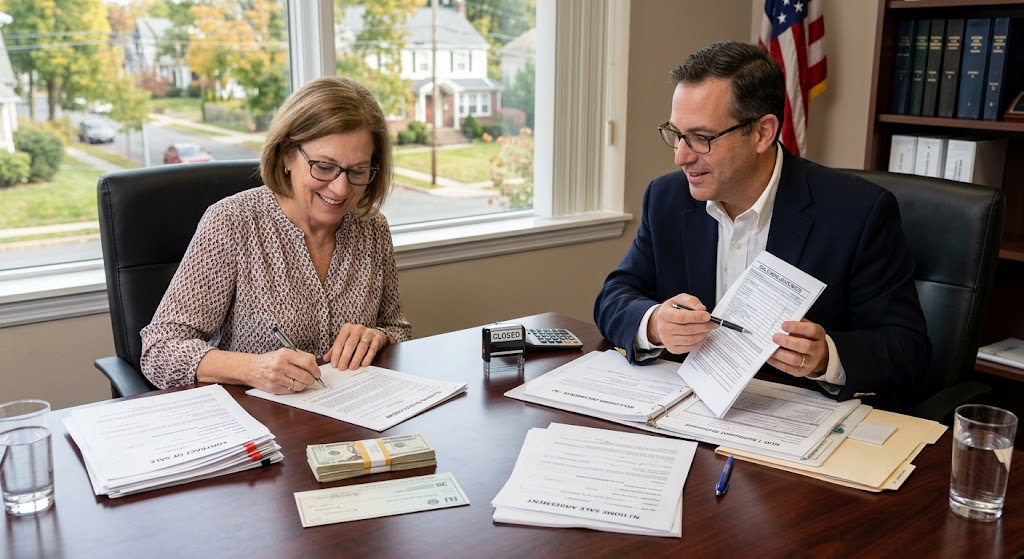
If you are selling directly to a cash buyer, you may want an attorney to review the purchase agreement and explain what you are signing before the transaction moves forward.
What Are Real Estate Attorney Closing Costs?
Real estate attorney closing costs are the fees charged by an attorney for legal work related to a property transaction.
The attorney’s work can include:
- Reviewing or preparing the purchase agreement
- Reviewing title information
- Communicating with the buyer or buyer’s attorney
- Addressing liens or title problems
- Reviewing closing documents
- Coordinating with the title company
- Handling legal issues that arise before closing
- Reviewing the final settlement statement
Attorney fees vary by attorney and transaction. There is no single statewide fee that applies to every home sale.
Before hiring an attorney, ask for an explanation of the expected legal fee and whether additional charges may apply if unexpected title, lien, or document issues arise.
What Other Closing Costs Can a New Jersey Home Seller Have?
Attorney fees are only one part of the closing costs. Depending on the transaction, a New Jersey seller may also encounter several other expenses.
Realty Transfer Fee
New Jersey imposes a Realty Transfer Fee (RTF) on the seller for recording a deed when real property is transferred, unless an applicable exemption applies. The fee is calculated using the consideration stated in the deed or, in certain situations, the property’s assessed valuation.
The current fee schedule is graduated, meaning the amount changes according to the consideration involved in the transaction.
For certain qualifying transfers over $1 million, New Jersey also has a Graduated Percent Fee. The seller is responsible for this additional fee under the current rules.
Because these fees can change based on the property’s sale price and circumstances, sellers should confirm the applicable amount before closing.
Outstanding Mortgage or Liens
If you still have a mortgage on the property, the outstanding loan generally needs to be paid from the sale proceeds at closing.
Other liens or judgments against the property may also need to be resolved before ownership can be transferred. These issues can affect the amount of money you receive from the sale and may sometimes delay closing.
Property Tax and Other Adjustments
Your closing statement may also include adjustments for items such as property taxes, utilities, homeowner association charges, or other property-related expenses.
The exact adjustments depend on the property and the closing date.
Real Estate Commission
If you use a real estate agent, the listing agreement determines the compensation paid to the brokerage. Selling directly to a cash buyer can be structured differently because there may not be a traditional listing and buyer-agent process.
However, you should always review your agreement carefully to determine whether any commission or other contractual payment is owed.
Does a Cash Home Buyer Pay Closing Costs?
There is no universal rule requiring a Cash Home Buyer to pay all or any particular closing costs. Who pays each expense depends on the purchase agreement and applicable law.
Some direct home-buying transactions may involve the buyer agreeing to cover certain customary closing expenses. Others may assign particular costs to the seller.
This is why you should not assume that an advertised “cash offer” represents the exact amount you will receive. Ask for a clear breakdown of:
- Purchase price
- Attorney fees
- Transfer fees
- Title-related costs
- Liens or mortgage payoff
- Property tax adjustments
- Other deductions
- Estimated net proceeds
The contract should make the responsibilities of both parties clear.
Are Closing Costs Lower When You Sell to a Cash Buyer?
They can be different, but a cash sale does not automatically mean that every closing cost disappears.
A cash buyer generally does not need a mortgage lender, which can remove certain buyer-side financing expenses such as lender origination charges, mortgage-related underwriting costs, and some financing contingencies.
For the seller, however, expenses such as the New Jersey Realty Transfer Fee and legal or title-related work may still apply.
The biggest potential difference may come from the structure of the transaction. If you sell directly instead of listing the property traditionally, you may avoid some expenses associated with a conventional listing, depending on the agreement.
That is why comparing the net proceeds can be more useful than comparing only the advertised purchase price.
What Does a Seller Receive at a Cash Closing?
At closing, the purchase price is generally used to satisfy the financial obligations connected with the transaction before the remaining proceeds are delivered to the seller.
For example, the calculation may look generally like this:
Purchase Price − Mortgage Payoff − Liens − Seller Closing Costs − Other Adjustments = Estimated Net Proceeds
The actual calculation can be more complicated depending on the property and transaction.
If you have no mortgage and no significant liens, your net proceeds may be closer to the agreed purchase price after applicable seller expenses. If you have substantial debt against the property, the difference can be much larger.
What Should You Ask a Cash Home Buyer Before Signing?
If you are considering a Cash Home Buyer, ask specific questions before signing the purchase agreement.
- What is the exact purchase price?
Make sure you understand the amount the buyer is offering and whether it can change under the agreement.
- Which closing costs will I pay?
Ask the buyer to identify the costs assigned to you and those the buyer intends to cover.
- Are there any additional fees?
Ask whether there are administrative fees, service fees, inspection-related charges, or other deductions that could affect your proceeds.
- Who selects the title company or closing attorney?
Knowing who is handling the closing can help you understand the process and identify the professionals involved.
- What happens if there is a title problem?
Ask how existing liens, judgments, probate issues, or other title concerns will be handled.
- When will I receive my proceeds?
The purchase agreement should establish the expected closing process and how funds will be delivered.
If something in the agreement is unclear, consider having a qualified New Jersey real estate attorney review it before signing.
Is Selling for Cash Better Than Listing With an Agent?
The two approaches can have different costs, timelines, and responsibilities. There is no single option that is appropriate for every homeowner.
A traditional listing may provide access to the broader open market but can involve preparation, showings, negotiations, commissions, and a longer transaction process.
A direct cash sale may offer a different process, particularly for owners who value a simpler transaction or who have a property that needs significant work. However, homeowners should compare the complete terms rather than focusing only on speed.
When comparing offers, consider:
| Factor | Traditional Sale | Cash Sale |
| Buyer financing | Often involved | Usually not required |
| Property preparation | May be expected | May be less extensive |
| Showings | Often required | May be limited |
| Financing contingency | May apply | Typically not needed |
| Agent involvement | May apply | May be direct |
| Closing costs | Vary | Depend on agreement |
| Closing timeline | Varies | Depends on contract and title |
The right comparison is not simply “cash versus traditional.” It is what will each option cost, how long will it take, and how much will you actually receive?
What If You Want to Sell My Home on Cash Because of a Difficult Situation?
Some homeowners consider a cash sale because they are dealing with a property that needs repairs, an inherited house, an unwanted rental property, financial pressure, or a pending foreclosure.
The reason for selling does not remove the importance of understanding the transaction.
For example, if foreclosure is involved, the timing of the sale can be particularly important. Homeowners should understand the current status of the foreclosure and any deadlines before entering into a purchase agreement.
If foreclosure is part of your situation, you can review foreclosure solutions from DS Realty Group Home Buyers to learn more about the service offered by the company.
How Can You Estimate Your Net Proceeds?
Before accepting a cash offer, create a simple estimated closing statement.
Start with the proposed purchase price and subtract:
- Mortgage payoff
- Known liens or judgments
- Realty Transfer Fee
- Attorney fees
- Title or settlement expenses assigned to you
- Property tax or other adjustments
- Any other contractual deductions
The remaining amount is your estimated net proceeds.
Remember that some costs cannot be determined accurately until the title search, payoff statements, and closing documents are completed.
For nonresident sellers, New Jersey also has specific estimated Gross Income Tax payment requirements that can apply at closing, subject to applicable exemptions and waivers.
Frequently Asked Questions
How much are real estate attorney closing costs in New Jersey?
There is no single statewide attorney fee for every transaction. The amount depends on the attorney, property, transaction complexity, and services required. Ask the attorney for a fee estimate before proceeding.
Does a cash buyer pay the seller’s attorney fees?
Not automatically. The purchase agreement determines which party is responsible for particular expenses. Review the contract carefully before signing.
Does selling a house for cash eliminate closing costs?
No. A cash sale may eliminate certain financing-related costs associated with a buyer’s mortgage, but seller expenses such as the New Jersey Realty Transfer Fee can still apply.
Is a real estate attorney required to sell a house in New Jersey?
New Jersey does not require every residential seller to retain an attorney by statute. However, attorney involvement is common in New Jersey transactions, and legal review can help sellers understand their rights and obligations.
What is the biggest closing cost for a home seller?
There is no single expense that is largest for every seller. Depending on the transaction, costs can include agent compensation, transfer fees, attorney fees, mortgage payoff, liens, and property-related adjustments.
Can I sell my home for cash if I still have a mortgage?
In many cases, yes. The mortgage payoff generally needs to be satisfied from the transaction proceeds, subject to the terms of the sale and the amount owed.
Should I have an attorney review a cash home-buying contract?
It can be useful, particularly when you are unsure about the purchase agreement, closing costs, contingencies, title issues, or other legal terms. A qualified New Jersey real estate attorney can provide advice specific to your situation.
Conclusion
Understanding real estate attorney closing costs is an important part of selling a home in New Jersey. A cash sale can have a simpler structure than a financed transaction, but it does not automatically eliminate seller expenses.
If you are considering a Cash Home Buyer, look beyond the headline offer. Review the purchase agreement, identify who is responsible for each closing cost, check for liens and mortgage balances, and calculate your estimated net proceeds.
If your goal is to sell my home on cash, you can learn more about DS Realty Group Home Buyers and its home-buying services. Before signing any contract, consider having the agreement reviewed by a qualified professional who can explain how the terms apply to your specific situation.